Name the intervention first
SURMOUNT-1 randomized adults without diabetes to weekly subcutaneous tirzepatide or placebo for 72 weeks; SURMOUNT-2 included type 2 diabetes. Both studied overweight or obesity.[1]
A useful causal question names something that could be changed and the alternative against which that change would be judged. Asking whether assignment to a treatment changes an outcome is therefore different from asking which part of the experience under treatment produces that outcome. The second question requires a more specific comparison. Before reading a result as an explanation, we need to decide what action the explanation imagines and what would remain the same.
Consider the difference between changing an assignment and changing a later experience while holding the assignment fixed. Those actions need not create the same comparison, even when the same outcome interests us. If an explanation moves between them without saying so, its conclusion can sound more definite than its question permits. Naming the action also exposes ambiguity: preventing an experience, reducing its intensity, and changing how it is recorded would be different interventions.
That distinction gives readers a practical starting point for a shared reading discussion. Write the proposed conclusion as a comparison between specified alternatives. Then ask which alternative each observation represents. If the intended alternative has not been defined, more precise arithmetic cannot supply it. A well-formed question comes before choosing an estimate, because the meaning of the estimate depends on what the comparison is supposed to represent.
What enters the symptom group
The post hoc primary category required one reported nausea, vomiting or diarrhea event (N/V/D).[2]
A category is a rule for sorting records. Its negative side means that the rule was not met; the label alone cannot establish that every potentially relevant experience was absent. This distinction becomes especially important when a short label replaces a longer definition. The longer definition sets the boundary of the inference. Expanding that boundary would require additional observations, rather than a more reassuring interpretation of the existing label.
There is also a difference between knowing how common separate categories are and knowing how they overlap. If a person could qualify for more than one category, adding their percentages would count that person more than once. Separate proportions leave the intersection unresolved. A comparison of their lengths could describe relative frequency under their definitions, but it would not reveal which individuals shared experiences or how those experiences occurred together over time.
Even an exact classification rule leaves a further measurement question: what opportunities would a record have to meet it? If observation opportunities differed, the same label could conceal different amounts of information. That is a reason to ask about the recording process, not an assertion that a particular difference occurred. A convincing category comparison should explain both the membership rule and the information to which the rule was applied. Otherwise, an apparent absence may be doing more explanatory work than the definition allows.
Another question concerns what would happen if the boundary changed. If a category became broader, membership could increase without anyone's experience changing. A difference created by redefining the category would therefore need to be distinguished from a difference in experience.
A category is a choice
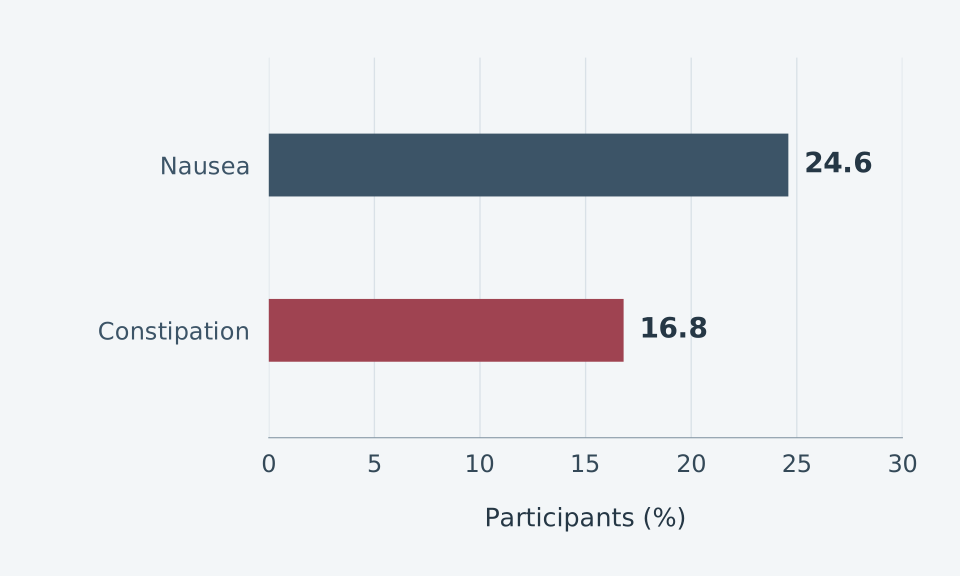
Read the chart as a table
| Symptom | Participants (%) |
|---|---|
| Nausea | 24.6 |
| Constipation | 16.8 |
Separate the outcome from its explanation
The original trials measured percentage weight change. Their efficacy estimand excluded post-discontinuation data; the treatment-regimen estimand retained outcomes regardless of discontinuation.[1]
Mean weight fell in both tirzepatide N/V/D groups.[2]
An outcome description and an explanation have different logical jobs. A description states what a measurement summarizes. An explanation proposes why that pattern arose and should specify what would change if the proposed cause changed. Agreement between an observation and an explanation is useful only to the extent that competing explanations would predict something different. If several accounts allow the same observation, that observation cannot choose among them on its own.
Consider a claim that an experience is necessary for an outcome. Necessity means the outcome could not occur without that experience under the conditions being discussed. A claim that the experience contributes to the outcome is weaker: other influences could also produce change. These propositions require different evidence. Neither becomes a claim of sufficiency, which would say that the experience by itself ensures the outcome. Keeping those meanings separate prevents one broad word, such as 'explains,' from carrying incompatible conclusions.
A group average introduces another layer. If individual responses differ, their average need not describe any one member's response. Similar averages could also coexist with different distributions, while a difference in averages would not identify its cause. To evaluate an individual prediction, we would need information about variation and about which characteristics make the comparison relevant. To evaluate a mechanism, we would need a comparison that distinguishes the proposed pathway from alternatives. Precision about an average cannot substitute for either requirement.
If an estimate came with a narrow uncertainty interval, that would not remove an ambiguity in its causal meaning. The interval would answer a precision question under the method's assumptions. It would not test every alternative explanation. Asking whether an estimate is stable and asking whether it identifies a mechanism are therefore separate evaluations.
The missing counterfactual
ICH cautions that comparing subsets formed by actual post-treatment events can confound treatment effects with differences between the people selected.[3]
The counterfactual is the alternative outcome that the causal question asks us to imagine. For a symptom contribution, the difficult comparison is between what would happen to the same eligible people with and without a specified change in that symptom, under otherwise appropriate conditions. We cannot turn two observed labels into that comparison merely by giving the labels opposite names. The intended alternative must have a meaning beyond membership in a recorded group.
One way to examine the logic is to list what should stay fixed when the proposed cause changes. If the comparison also changes the treatment, the people being compared, or the opportunity to measure an outcome, an explanation must account for those changes. This does not require assuming that any particular imbalance occurred. It requires making clear which differences the proposed interpretation treats as irrelevant and why that treatment of them would be defensible.
Adjustment would then have a specific task: support comparability for the question being asked. It would not make an ill-defined intervention meaningful. Nor would collecting more observations automatically settle which alternative those observations represent. A useful sensitivity question is whether a plausible difference left unresolved could alter the interpretation. If so, the conclusion should depend visibly on the assumption that addresses that difference. This preserves the distinction between uncertainty about an estimate and uncertainty about whether the estimate answers the intended causal question.
Which measurements remain
Weight analyses excluded post-cessation measurements and, in SURMOUNT-2, measurements after antihyperglycemic rescue.[2]
An analysis rule can select measurements without removing every contribution from the person who supplied them. To understand its effect, first identify the target outcome and the time at which that outcome is defined. Then distinguish a measurement outside that target from a relevant measurement that was not obtained. Those situations call for different reasoning. Calling both 'missing' would obscure whether the question changed or whether information needed to answer it is unavailable.
Suppose an outcome relevant to the chosen question were unobserved. Replacing it with a predicted value would require a relationship between what is known and what is unknown. The prediction would remain an assumption-bearing estimate, even if it were calculated consistently. Its credibility would depend on whether the proposed relationship remained suitable for the people and circumstances with unavailable outcomes. A sensitivity analysis could ask how the conclusion changes under alternative relationships; it would not create a new observation.
Conversely, keeping every available measurement does not guarantee that they all answer the same question. An analysis could become harder to interpret if it combined observations with incompatible meanings. The solution is to state the question before deciding which records belong. Readers can use the companion observation analysis to examine measurement boundaries. A shared reading discussion can then ask a precise question: would including another observation improve the answer to the existing question, or quietly substitute a different question?
Where the comparison starts
SURMOUNT-4 randomized participants reaching a tolerated dose after 36 weeks of open-label treatment to continuation or placebo for 52 further weeks: 88 weeks overall.[4]
A starting point does more than set a clock. It defines the conditions under which the next comparison is made. If eligibility depends on reaching a particular stage, the resulting question concerns people who reach that stage. A reader interested in an earlier decision would need an additional argument connecting the two settings. That connection cannot be supplied simply by extending the later result backward in time.
The reference measurement matters as well. Change from an initial enrollment measurement and change from a later decision point subtract different starting values. Even when both calculations concern the same final outcome, they describe different intervals. A clear account should identify the interval before attaching a causal interpretation to its change. Otherwise, an experience that preceded the comparison could be mistakenly treated as an effect of the decision made when the comparison began.
Selection at entry does not make every subsequent contrast uninformative. It can define a coherent, narrower question. The key is to keep that question attached to its entry conditions when discussing relevance elsewhere. To transfer an interpretation to another starting point, we would need to explain which prior experiences matter and whether their distribution would differ. A later comparison can be useful without resolving every question about reaching the point at which it starts.
A model needs more than two groups
Exploratory mediation covered SURMOUNT-1–3 only.[2]
A mediation argument tries to divide an overall effect according to a proposed pathway. That division requires more than noticing that a possible intermediate experience and an outcome occur together. We need to say what would count as changing the intermediate experience while preserving the other features required by the question. If different ways of making that change would have different consequences, the phrase 'remove the symptom' is not yet a sufficiently specific intervention.
The scale of the proposed division also matters. A fraction of an estimated treatment effect uses that effect as its denominator. A percentage-point difference in an outcome uses the outcome scale. These quantities answer different questions and cannot be exchanged by dropping their units. If the denominator changed, the fraction could change even without an equivalent change on the outcome scale. Interpretation therefore requires following both the comparison and the units through each step of the argument.
An intervention intended to alter an intermediate experience could also affect the outcome through another route. If that were possible, its observed effect would not automatically isolate the contribution attributed to the experience itself. The analysis would need a reason to separate those routes or a question that explicitly includes both. This is why a model's internal calculation and the causal meaning assigned to its components deserve separate scrutiny. A coherent calculation can still depend on assumptions that the observed association alone cannot settle.
An explanatory model should also make clear which parts of its decomposition are defined by convention and which depend on evidence. If two valid parameterizations described the same observations, choosing between their labels would not establish a biological pathway. Agreement about notation should not be mistaken for agreement about what an intervention would do.
Who produced the evidence
Lilly funded the analysis; six authors were employees/shareholders.[2]
Disclosure supplies information about who produced an analysis; it does not perform the analysis's validity checks. The useful response is to make those checks inspectable. Could another reader trace the question to the chosen outcome, reconstruct the comparison, and identify the assumptions needed for the conclusion? If an interpretation depends on a discretionary choice, the reasoning should explain that choice rather than relying on confidence in the people who made it.
Reproducing a calculation and testing its interpretation are distinct tasks. The same result could be reproduced under an assumption that deserves further examination. Conversely, a difference between calculations could arise from different definitions of the target question. Before treating agreement as confirmation or disagreement as refutation, establish what each calculation is attempting to estimate. Otherwise, an apparent dispute about reliability might actually be a dispute about the comparison under discussion.
A stronger test of an explanation would specify in advance what observation could distinguish it from a competing account. It would also define how the relevant comparison could be maintained when circumstances changed. These are proposals for evaluating an argument, not claims about omitted procedures. Readers can consult our editorial methodology to examine publication standards separately. Transparency is most useful when it lets a reader locate a consequential assumption and assess how much of the conclusion rests on it.
If a proposed finding survived a change in analytic choices, that would answer only the sensitivity question those choices address. Robustness should be named specifically, so it does not become an unrestricted claim that every assumption has been tested.
Keep the clinical question separate
Zepbound delays gastric emptying and is not recommended in severe gastroparesis. Contraindications include personal or family history of medullary thyroid carcinoma, MEN2, or prior serious hypersensitivity to tirzepatide or product ingredients. Persistent or severe abdominal pain needs prompt assessment; dehydration can injure kidneys.[5]
Compounded products lack FDA approval.[6]
A causal interpretation cannot, by itself, decide what an individual should do about a concern. An action requires its own question about the alternatives and their consequences. It would be a category error to turn a proposed explanation of an outcome into a threshold for ignoring an experience. Readers can use the peptide reference library to organize product-specific reading for that separate clinical discussion.
Service research is another distinct inquiry. Use the CoreAge Rx service review to examine dated documentation and distinguish documented commitments from unanswered questions. A treatment comparison cannot establish the commitments of a service. Keeping these inquiries separate allows a reader to bring a precise uncertainty to the appropriate conversation without treating a statistical association as a personal instruction or a provider guarantee.
Answer the stated question
A conclusion should identify the comparison that makes it meaningful. The strength of an interpretation depends partly on whether a different account would fit the same observations. If competing accounts remain compatible, the next useful step is to specify what additional contrast would separate them. That proposal should name the action, the outcome and the conditions that need to remain comparable. A request for more data becomes scientifically useful when it explains which unresolved ambiguity those data would address.
Confidence and scope should also be considered separately. A narrowly defined comparison can support a confident conclusion within its boundary, while a broader claim may remain uncertain. Broadening the wording does not broaden the evidence. For a shared reading discussion, the most productive disagreement may concern which question deserves priority, rather than which summary sounds more reassuring. Once the question is explicit, readers can assess whether the evidence is relevant, which assumptions connect it to an explanation, and where a different comparison would be needed.
Reader questions
Does a symptom-free category mean every digestive symptom was absent?
A negative label should be read through its stated definition. Before interpreting it more broadly, ask which experiences the rule would recognize and which it would leave unclassified. The key logical test is whether the conclusion refers to the same set of experiences as the rule. If the conclusion covers a larger set, observations about that additional set would be needed; a shorter label cannot supply them.
Can two group averages identify a mechanism?
Two averages summarize a contrast, but a mechanism is an explanation of how an effect arises. To distinguish explanations, ask what each would predict under a specified change and whether those predictions differ. If both explanations permit the same averages, additional precision about those averages would leave the ambiguity intact. A useful next comparison would target the point where the explanations make different predictions.
What changes when follow-up begins after prior treatment?
The relevant question moves to a new starting condition. Ask which prior experiences are part of that condition and which later changes the comparison is meant to explain. This separates learning about a decision at that point from learning about reaching it. Applying the answer to an earlier decision would require an explicit connection between the two situations, rather than assuming that the later comparison covers the whole course.
What to take from the evidence
The most defensible explanatory claim is one whose required comparison can be stated without changing meaning halfway through the argument. That means keeping the intervention, outcome definition, eligible population and observation period aligned. When the proposed explanation concerns an intermediate experience, a remaining ambiguity is whether changing that experience would preserve the other conditions needed for the comparison. A stronger investigation would specify such a change and explain how its consequences could be separated from competing routes to the outcome. Until that ambiguity is resolved, interpretation should identify the assumptions on which it depends. This approach gives uncertainty a concrete role: it directs the next comparison toward the unresolved explanation, rather than using caution as a substitute for answering a well-defined question.
Scope of this article
This article interprets research questions and comparisons for general education. It does not report a clinical review or offer individualized treatment advice. The discussion cannot determine a reader's response, establish a service's clinical quality, or replace assessment by a licensed clinician.