Decide what is being compared
STEP 1–3 studied adults with overweight or obesity for 68 weeks. STEP 2 included type 2 diabetes; STEP 3 used intensive behavioral therapy. The tested regimen was weekly subcutaneous semaglutide 2.4 mg versus placebo.[1]
Calling a treatment tolerable leaves the central comparison unspecified. The statement could concern what someone experienced, how an occurrence was classified, or whether an outcome differed between treatment groups. These questions can concern the same experience. A record connects them only after its meaning is established. Before interpreting a summary, the reader needs to know what would qualify for inclusion and what an absence from that summary would mean.
A comparison also requires a common rule. If the same description would qualify on one side but be excluded on the other, a numerical difference could reflect classification as well as experience. This is a logical condition for interpreting a contrast, not an allegation about these trials. Naming an outcome precisely helps identify which differences the analysis is designed to detect and which distinctions it deliberately leaves unresolved.
Specifying the intervention and setting serves a related purpose. It gives the claim a defined object rather than making it a statement about every possible use of a medicine. A narrow comparison can be informative because its terms are clear. The scientific task is to preserve those terms in the conclusion, rather than letting a broad word such as tolerability carry more meaning than the comparison supplies.
From an experience to a record
The GI analysis was post hoc.[2]
An experience does not arrive in a dataset already divided into useful units. A record needs a description of what happened, a decision about the category it belongs to, and a way to locate it in time. A detailed account might establish that something occurred while leaving its beginning uncertain. Conversely, a precise date would not resolve an ambiguous description.
Consider reporting delay as a measurement possibility. If an occurrence were described later, the reporting date and the occurrence date would differ. Assigning the record to the former would answer when information became available; assigning it to the latter would answer when the experience was said to happen. Neither choice should be mistaken for the other. This example identifies a distinction that a reader should understand, without asserting that delayed reporting affected the study.
Closing an episode creates another boundary. If an experience stopped and returned, a recording rule would need to determine whether that history constituted separate episodes. A follow-up question could clarify an unresolved account without necessarily adding another occurrence. Thus, adding detail to a record and adding an event to a count are not equivalent operations.
Incomplete information also calls for a different conclusion from an explicit negative report. An empty field alone cannot establish whether an occurrence was absent, unreported, or insufficiently described. Those possibilities should not be treated as interchangeable merely because they would leave the same blank space. The value of a recording rule lies partly in making such uncertainty visible instead of quietly converting uncertainty about a description into certainty about an experience.
Two labels, two questions
In STEP, severe events prevented normal everyday activities.[2]
Seriousness covers death, immediate danger to life, inpatient admission or prolonged hospitalization, persistent or significant disability, birth defects, and other medically important events. Severity describes intensity; these categories can overlap.[3]
The distinction creates a cross-classification, not a ladder on which every experience occupies one rung. A ladder would imply an ordering: moving into one category would automatically settle the other. Separate classification questions do not have that property. Knowing the answer to one leaves another question open, so neither label should be used as a shortcut for all the information the record might contain.
Adding or subtracting category percentages is arithmetically possible without knowing their intersection. The interpretation is a separate question. If categories can overlap, their sum cannot be treated as the percentage of unique people in at least one category without accounting for shared membership. Their difference describes a contrast between the separate percentages; it does not, by itself, identify the percentage belonging only to one category. Identifying an exclusive subgroup or the combined group requires information about overlap.
There is also no temporal order encoded in the arrangement. A row placed beneath another is not a later stage, and a longer bar is not evidence that one classification develops into the other. Such claims would require linked histories and an explicit account of change. Display order cannot supply a sequence that the underlying comparison has not established.
Finally, a classification is an answer to a defined question, not a complete appraisal of an experience. Failure to meet one criterion does not make every other description irrelevant. Keeping the questions separate allows the record to retain several meanings without forcing them into a single reassuring or alarming label. That is the useful discipline here: interpret each category according to the question it was constructed to answer.
Two classification questions
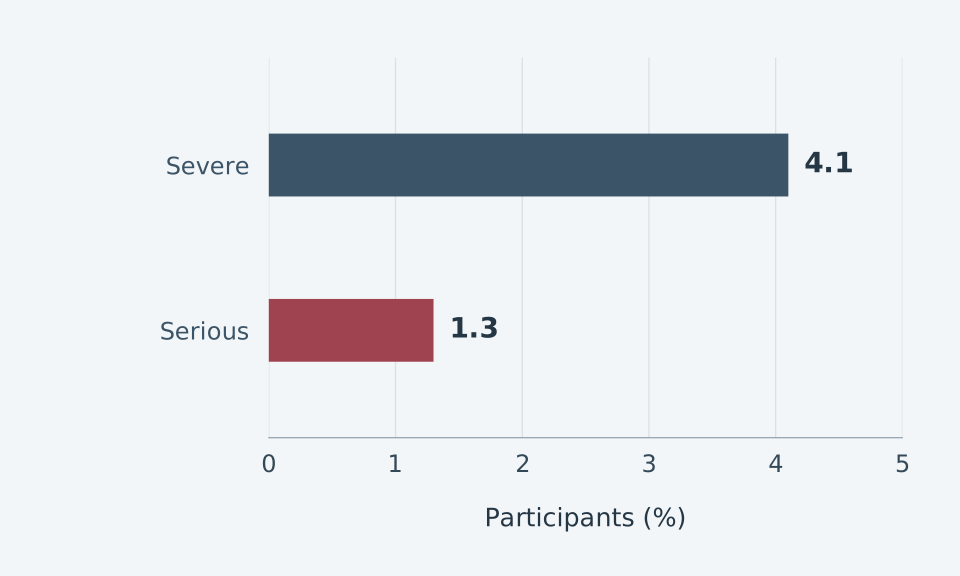
Read the chart as a table
| Classification | Participants (%) |
|---|---|
| Severe | 4.1 |
| Serious | 1.3 |
Make the observation window explicit
Week-68 weight observations required dosing within the preceding two weeks.[2]
An observation window decides which records may contribute to a summary. Moving its boundary could change the summary even if the underlying history remained identical. The change would not necessarily indicate disagreement about what happened; it could reflect a different decision about which part of that history belongs to the question. The boundary is therefore part of the meaning of a result.
Occurrence time and collection time need separate attention. Information obtained after a boundary might describe an experience before it. Information obtained before the boundary could concern an episode whose ending remained unknown. A rule based on when an experience occurred would handle these situations differently from a rule based on when the information arrived. Neither a date on a form nor the position of a record in a file resolves that distinction by itself.
Different outcomes also need not use identical eligibility rules. Their summaries can coexist, but placing them next to each other does not establish that they describe the same span or the same set of observations. An interpretation that connects the outcomes must explain why those differing boundaries are compatible with the proposed connection. Otherwise, apparent agreement between summaries could answer less than the reader assumes.
An endpoint association is particularly easy to overextend. It describes a relationship at the chosen analytical endpoint, not a continuous account of every intervening day. To make a claim about the path between observations, the analysis would need information about that path. The appropriate response to a bounded result is therefore to retain its boundary in the conclusion, rather than filling the unobserved interval with an imagined course.
A curve needs a question
The trial program collected adverse events through off-treatment follow-up; STEP 1–3 included seven follow-up weeks.[1]
Before reading the shape of a curve, establish what would make it move. In a cumulative first-occurrence curve, a person's first qualifying record supplies the relevant change. A later recurrence cannot become another first occurrence for that person within the same definition. The curve therefore cannot, by itself, distinguish a history containing one episode from a history containing repeated episodes after the initial record.
Current prevalence asks a different question: who qualifies at the time being summarized? If such a curve fell, the decline alone would not identify which people stopped qualifying, which continued, or which newly entered the group. Several individual histories could produce the same aggregate movement. Linking observations within people would be necessary to distinguish those histories; visual inspection of the aggregate curve would not recover them.
Recurrence and unresolved duration introduce further distinctions. Repeated episodes require a rule for separating one occurrence from another. Duration requires both a beginning and an ending, or an explicit way to represent an ending that has not been observed. A count of episodes does not provide their lengths, while a duration summary does not identify how many separate episodes contributed. Neither should silently stand in for the other.
Smoothing a line, changing its scale, or adding more time points cannot turn one kind of summary into another. The reader should first identify the event that changes the plotted quantity, then ask what information the quantity leaves behind. That order makes the graph interpretable before any judgment about whether its shape appears reassuring, unusual, or clinically meaningful.
Where the comparison starts
STEP 4 randomized participants after a 20-week run-in, requiring attainment and continued use of the target dose. The randomized comparison then lasted 48 weeks.[4]
A comparison begins at a defined starting point, and eligibility at that point determines whose subsequent histories can contribute. It defines the circumstances under which the alternatives are compared. Moving the starting point can therefore create a different scientific question even when the treatment names remain unchanged.
Continuing versus withdrawing an intervention asks about alternatives after prior exposure. Starting versus never starting asks about alternatives before that exposure. Substituting the answer to one question for the answer to the other would require justification about the histories that precede the comparison. The shared presence of a treatment label is not enough to establish that the alternatives are equivalent.
A later starting point can be appropriate when the objective concerns what happens next under defined conditions. Its usefulness does not depend on answering every earlier question. But evidence gathered after that point cannot restore experiences that were outside eligibility for the later comparison. Those experiences belong to a different inquiry, with a different starting population and potentially different alternatives.
This distinction also clarifies the role of selection. Describing the conditions for entry makes the scope of the comparison inspectable. It does not, by itself, establish the direction or size of any difference from another population. The sound conclusion identifies where the comparison begins and avoids assigning it authority over a beginning it did not examine.
What follow-up cannot prove
ICH distinguishes a treatment-effect question from its estimator and result, and separates uncollected relevant data from measurements outside the chosen question.[5]
Obtaining another observation, choosing to include it in a calculation, and using it to explain why an outcome occurred are separate operations. More information can clarify a recorded history without identifying the cause of that history. The explanatory step needs a comparison between alternatives, including an account of why the observed difference would be attributable to the proposed cause rather than another difference between those alternatives.
Suppose a symptom preceded a later change. That ordering would be compatible with a causal explanation, but compatibility is weaker than identification. The ordering alone would not reveal what the later outcome would have been without the symptom. Nor would dividing records according to symptom status create a controlled intervention on the symptom. The relevant alternative remains an unobserved possibility unless a design or justified analytical argument makes it estimable.
Longer follow-up would not automatically resolve this problem. It could provide a more complete sequence while leaving the same uncertainty about the alternative sequence. Similarly, a precise calculation could express little numerical uncertainty while still depending on an uncertain causal interpretation. Precision within a chosen comparison and credibility of that comparison are different forms of confidence.
The question is not whether a limited analysis has failed by being limited. It is whether its answer has been attached to the question it can address. A descriptive relationship may be useful without establishing an explanatory pathway. A separate discussion in the companion comparison analysis develops that distinction. Here, the boundary is between documenting a sequence and claiming that changing one part of the sequence would change another.
Make assumptions inspectable
Novo Nordisk funded the trials and writing; three authors were employees and shareholders.[2]
A disclosure identifies relationships that belong in an appraisal of the work. It does not perform the appraisal. Accepting or rejecting a result solely from that information would bypass the reasoning needed to assess the comparison. The useful next step is to make the analytical commitments visible enough that someone who did not make them can examine their consequences.
Some commitments concern whether definitions are comparable. Others concern who qualifies for an analysis or which observations belong within it. For each, the reader can ask what conclusion depends on the commitment and what a reasonable alternative would change. This makes scrutiny specific. It replaces a general suspicion or endorsement with an argument about the connection between a decision and an interpretation.
Reproducing a calculation and testing an assumption also serve different purposes. Reproduction asks whether the stated inputs and operations yield the stated output. An assumption check asks whether another defensible formulation would support the same interpretation. Agreement on the calculation cannot settle every question about the formulation, while sensitivity to a formulation need not imply that the arithmetic was wrong.
The corresponding editorial obligation is to show the basis for a claim and preserve its limits when summarizing it. Readers can consult our editorial methodology for the publication process; it is not evidence for a scientific result. Keeping those roles distinct allows editorial transparency to support scrutiny without using a process statement as a substitute for examining the underlying comparison.
Keep clinical context separate
Wegovy delays gastric emptying and is not recommended in severe gastroparesis. Contraindications include personal or family history of medullary thyroid carcinoma, MEN2, or prior serious hypersensitivity to semaglutide or product ingredients. Persistent or severe abdominal pain needs prompt assessment; dehydration can injure kidneys.[6]
Compounded drugs are not FDA approved.[7]
A historical classification does not decide what an individual should do now. Its purpose is to organize observations for a defined analysis, while a present clinical question requires an assessment of the present circumstances. Moving directly from a category label to a personal action would skip that assessment. This article does not make that move.
For product-specific reference context, readers can consult the peptide reference library. For service documentation, the CoreAge Rx service review is a separate inquiry that should be checked against dated provider materials. A service claim requires evidence about that service; a trial comparison cannot supply it by association. Keeping these reading paths distinct prevents a reference link from becoming an implied endorsement, an outcome prediction, or a promise about what a provider will arrange.
Keep the conclusion aligned
A useful conclusion should make its next inference visible. If the claim concerns a difference between recorded categories, the supporting comparison must establish that difference. If it concerns why an outcome occurred, the argument must go further and justify the relevant alternative. The strength of the conclusion depends on completing the required step, not on how confidently the result is described.
This creates a practical test of interpretation: could the same observations remain true while the proposed explanation was false? If so, the explanation needs additional support. That does not erase the observations. It locates the point at which an account of what was recorded becomes a claim about what produced it.
Agreement on the question is therefore a scientific achievement in its own right. It permits readers to disagree about an assumption without talking past each other about the outcome, the eligible history, or the intended comparison. A conclusion becomes more useful when it states exactly which inferential step the evidence supports and leaves the unresolved step open to examination.
Reader questions
Can two different event labels describe the same experience?
Yes. Separate classification questions can both apply to one experience without making either answer redundant. A shared label also does not establish that everyone carrying it shares every other characteristic. To combine category totals, the analyst would need to account for shared membership. To interpret one category, the reader needs its own rule, rather than assuming that a different label supplies the missing information.
Does a shorter observation window make a result wrong?
No. A result can correctly answer a question confined to a particular interval. The problem arises when the conclusion extends beyond that interval without justification, or when relevant observations within it are missing. Those situations require different responses. Defining a narrower question can clarify scope, but it cannot make unavailable information appear. The interval and the completeness of observation should be evaluated separately.
What would make a follow-up comparison more persuasive?
A more persuasive comparison would specify the intended question and measurements before interpreting the pattern, provide comparable opportunities to observe the alternatives, and address plausible competing explanations. Those features would make the connection between records and conclusions easier to examine. They would not remove every uncertainty. Their value would lie in showing which alternatives had been tested and which remained compatible with the observations.
What to take from the evidence
The strongest reading keeps the identity of the observation intact throughout the argument. A classification, an observation window, and an eligibility rule each constrain what can be inferred; none is merely a technical preface that can disappear from the conclusion. When these elements fit the question, a bounded comparison can be informative without claiming completeness. The remaining boundary is explanatory: compatible records do not necessarily distinguish between competing accounts of why an outcome occurred. Crossing that boundary requires evidence about alternatives, not simply a more emphatic description of the observed pattern. The appropriate scientific judgment is to preserve the supported comparison while identifying the additional argument an explanation would require. That leaves a useful finding open to further inquiry without treating uncertainty as either a verdict against it or permission to overstate it.
Scope of this article
This article examines how measurement choices constrain interpretation. It does not reconstruct individual records, establish a causal pathway, or assess a person's treatment suitability. The accompanying figure summarizes selected categories rather than a complete safety profile. Reference and service links serve separate editorial purposes and do not establish personal care recommendations.